
On Diversity
Why MAGA is wrong about America & Immigration

“I had always hoped that this land might become a safe & agreeable Asylum to the virtuous & persecuted part of mankind, to whatever nation they might belong.”
-George Washington
On September 19th 2025 Reverend David Black was shot in the head seven times by pepper-spray balls as he prayed during a protest outside an ICE facility. He later said that they laughed as they shot him. On July 10th 2025 Jaime Garcias died after falling 30 feet while being chased by ICE. On October 2nd 2025, Leo-Cruz Silva was transferred to an ICE facility. He was found dead the next day. The cause is under investigation. People have been beaten, threatened, chased, detained, and deported without trial. They have been restricted from desperately needed medical care. Dehumanized by the Governments’ social media. Used as a cudgel to justify a desperate authoritarian expansion of power. In August of 2025 Senator John Ossoff compiled a list of 500 credible incidents of human rights abuses by ICE- including 41 against pregnant women, and 18 against children. 16 human beings have died in custody as of September. The highest number on record.
This is one of the many fruits of the civilizational argument MAGA makes that I responded to in An American Manifesto in the Age of Trump. Their view is vibes-based more than it is rational, but there are ‘facts’ that underpin it that are worth responding to. Just as abortion was a foundational belief of conservatives for decades, the belief that the best, happiest, safest, and most trusting societies are homogeneous justifies the current inhumane crackdown for many. Once the belief germinates, it creates an antipathy that would not otherwise occur. That antipathy is a necessary precondition for MAGA’s present inhumanity.
Their perspective rests on two arguments- one national, the other universal. The national argument is that the United States has a set of particular values indelibly linked to a particular people. As such, changes to that people will lead to the elimination of the American tradition. The universal argument is that diverse societies are associated with lower trust, and lower social participation, with downstream negative impacts on crime, corruption, and mental health. I will first respond to the universal argument before moving to the national one. I will then argue why diversity is our strength.
“…you can go to live in France, but you can’t become a Frenchman. You can go to live in Germany or Italy, but you can’t become a German, or an Italian. He went through Turkey, Greece, Japan and other countries. But he said anyone, from any corner of the world, can come to live in the United States and become an American.”
- Ronald Reagan
“Diversity Universally Degrades Society”
Robert Putnam, author of the seminal work Bowling Alone and a well respected American academic wrote-
“Diversity does not produce ‘bad race relations’ or ethnically-defined group hostility, our findings suggest. Rather, inhabitants of diverse communities tend to withdraw from collective life, to distrust their neighbors, regardless of the color of their skin, to withdraw even from close friends, to expect the worst from their community and its leaders, to volunteer less, give less to charity and work on community projects less often, to register to vote less, to agitate for social reform more, but have less faith that they can actually make a difference, and to huddle unhappily in front of the television”
This is true, and it also sounds a lot like America today. As a 2020 analysis of 87 previous studies found, diversity has been consistently negatively correlated with trust, particularly among neighbors. Unfortunately for right wingers seeking to justify their intuitive discomfort towards the ‘other’, Putnam and subsequent academics’ findings are more nuanced than they may first appear. For ‘diversity’ is a broader term than its political equivalent. It does not just measure ethnic diversity, it also measures everything else, from religiosity, to language to cultural values. In other words, the breakdown in community can be fully explained by political polarization without having to look to our increased ethnic diversity. Another study found that the areas with the lowest trust were both highly diverse and highly segregated. The claim is not so much “diversity leads to low trust”, as it is “people tend to trust those they are most similar to.” Yet people can be more and less similar to each other in a variety of ways. This more complex picture of diversities impact can be seen in regional studies of trust in the United States.
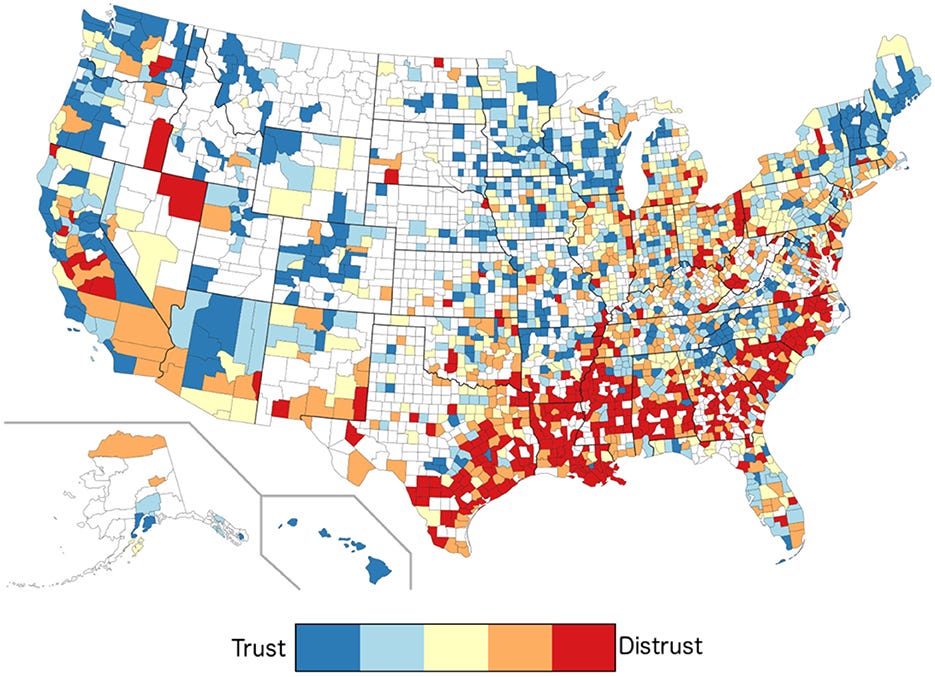
Looking at the map above one can see that the most ethnically homogeneous regions of the country- Appalachia, the Pacific Northwest, New England and some of the less urban counties in the mid-west, really do have higher levels of trust. At the same time, so do the hyper-diverse regions of coastal California, the state of Hawaii, the Texas Triangle, Atlanta, and much of the North-East megalopolis. On the other hand the still-segregated south is riven with distrust, while Detroit - a heavily segregated city - compares unfavorably to other diverse American urban areas that are more integrated. It is worth zooming in on the south and Hawaii to better understand how diversity effects trust. In the old south diversity is a black and white issue. But the color line is not just color, it touches every aspect of life. In all of these states most African Americans vote blue, but their state governments are deep red- adding an ideological component to the divide. Furthermore, while cities like Detroit or Chicago are heavily segregated, the states of the deep south are segregated, with entire strings of counties that are majority black, instead of blocks. The result is clear. Low social cohesion. Low voter turnout. Low trust. High crime. Compare that to Hawaii, which is about 40% Asian, 25% white, and 25% multiracial or other (read: Native Hawaiian). There are still social divides, Native Hawaiians make less than white Hawaiians, who make less than some groups of Asian Hawaiians. Religion is heavily fragmented, many languages are spoken, and almost 20% of Hawaiians are foreign born, with another 28% being born in another state or territory. By any metric this is about as diverse as a society can get. Nevertheless, while some level of segregation exists, there is more intermixing than in other parts of the country. The lack of a clear majority population undermines the importance of any one ethnicity, and the solid blue voting patterns show that there are greater ideological commonalities than the deeply divided deep south.1 As a result Hawaii is the highest trust and most diverse state in the union.
So the solution to American’s mutual distrust is not cutting off immigration, it’s increasing assimilation, language classes, and more. It is integrating those different from the majority - in any way - as fully as possible. The goal must be to make the most salient difference between you and your neighbor your individual traits, rather than any secondary characteristics. This has implications for people on the left as well. The salad-bowl metaphor is a step in the wrong direction, we remain a melting pot. If we want to successfully end racial and ethnic inequalities, then we should focusing on completing integration more than creating a system of benefits for minorities2. This should help us understand why substantial reparations to Native Americans starting in 1946, did not result in notable improvements in Native American conditions, while the incentivization of integration did.3 Native Americans and Black Americans are the only two minorities that make notably less than the average American4 and they are also the only two groups that have large segregated populations in 2025. The solution is not to draw up more color barriers, it is to minimize the importance of race. The solution is not to cut off immigration, it is to be good neighbors to them.
Even if the United States deported every person born in another country, we would remain a low trust society with high levels of crime.
“Nearly all Americans have ancestors who braved the oceans – liberty-loving risk takers in search of an ideal – the largest voluntary migrations in recorded history… Immigration is not just a link to America’s past; it’s also a bridge to America’s future.”
-George HW Bush
“America is a People”
The idea that America is inextricably linked to a particular ethnic stock is much more pernicious. It requires one to warp American history so profoundly that believers in this myth are completely divorced from reality. Before I get into the argument, it is worthwhile to recap the actual founding of this Nation. The United States has always been diverse. We were so religiously diverse at our founding that we invented secular Democracy. The 13 colonies had large populations of Germans, Catholics, French and other Europeans, as well as notable Native populations including tribes that had integrated into colonial society, and - of course - a large number of African slaves - 1/3rd of which could have been Muslim. As Father Isaac Jogues stated in 1643 in one of the earliest records of what would become New York-
“On it [New Amsterdam] are five or six hundred people of different sects and nations. The Director told me that there were men of eighteen different languages spoken there.”
It seems in some ways that New York has stayed the same since 1643. Maryland was founded as a Catholic refuge, Massachusetts as a Brownist/Separatist enclave of radical Puritans. This was about as diverse as a single nation could be in the late 1700’s. That diversity shaped our founding documents and our civic identity.
The argument to the contrary goes as follows- American liberty is an offshoot of the English Enlightenment, which is an offshoot of Protestant Christianity. The English stock and intellectual character of the founders was a necessary precondition to the eruption of the American Revolution. American ideals are, therefore, only sustainable with a Christian European background, as those from other cultural contexts cannot understand or believe our ideals. How can someone who does not believe in the Christian “equality in the eyes of God” get behind universal political equality? The more intellectually honest of those I have talked to that espouse this make a more limited claim that excludes Catholics and most Europeans as well. Others focus this argument on Muslim migrants and refugees while using it to mostly exclude Christian Latin Americans.
While it is true that the enlightenment, and prior Christian views did produce the intellectual tradition American liberalism sprung out of- ideological family trees are not like real family trees. A fish cannot be convinced to be a bird in the way a Chinese communist can be convinced to believe in the American liberal intellectual tradition. This makes cultural lineage’s messy, more of a conversation than a family tree. This eliminates ancestral “ownership” over particular events. One of the first enlightenment thinkers was Spinoza, a secular Jew who’s ideas came from a very Jewish worldview. Nobody would say that America is a Jewish country because of Spinoza’s influence on the founding ideology. Secularism itself comes out of Christianity, but nobody would say that secular atheists are culturally Christian. Historical influences are real but exist regardless of contemporary standards. No matter what America is like today, it will still have been founded by the same people with the same backgrounds.
Using all objective measures of American culture, immigrants are no threat to our way of life. In fact, American immigrants are more patriotic than native-born Americans. They are more likely to respect the founding fathers, support the bill of rights and the constitution, and even support English as the official language of the United States. They commit petty and violent crime at lower rates. Immigrants that serve in the military are more likely to win awards for valor- in fact 22% of winners of the medal of honor have been immigrants. Using the framework of valuing a particular American “culture”, one should instead argue that America cannot be America without immigration. They are more peaceful, patriotic, and willing to lay down their lives for their country than native-born Americans.
If every white American woke up brown tomorrow, America would still be America. If every American Christian lost their faith tomorrow, America would still be America. This need not undermine the massive influence that white and Christian peoples and traditions have had on this country. Indeed, their influence was so strong that it now exists independently from them.
So why is Diversity Good?
This paper is not about immigration, it is about the virtue of a diverse society. For societies to survive, stability is not sufficient. Ancient Egypt centralized early but its rigid structure stifled growth. Stability, when taken to an extreme, is rigidity. The strongest societies have an identity and culture that is able to transcend imagined human barriers. Throughout history the periods with the greatest innovation have been created by interactions between multiple cultures. The Renaissance was the product of a German printing press, Italian city-state led investment in the arts and sciences, and the rediscovery of classical sources through trade ties with the Arab world. In the American Revolution most of the founders were educated by Scots in their distinct intellectual tradition, while a milieu of different cultural and religious traditions were consciously mingled in order to create the first modern liberal state. The industrial Revolution was the confluence of a series of inventions- first made mostly in Great Britain but later constructed throughout Europe and the Americas. The modern information revolution-see vaccines produced by American companies using German-Turkish research teams, semiconductors using American Software, and being constructed by fabricators using German and Danish parts in Taiwan. The most innovative states today are the most diverse ones. The flexible and innovative, are the strong. There is a big difference from a diverse post-colonial nation- with no shared identity, not shared language, no shared culture, and a diverse industrial democracy- with an identity formed around ideals, a shared language, and culture.
This is not just technological. Considered by many to be the greatest painter in history, Van Gogh emulated Japanese prints when working out his style. So did my favorite artist- the Czech nationalist Alphonse Mucha. The American band has taken over the global musical scene, and it is an outgrowth of traditional African drums and stringed instruments mingling with Spanish Bandoras, European musical notation, and broadsides, as well as the particular traditions of the various immigrant groups that later came to America. I could go one with movies and the Jews, or literature and nationalism. Time and time again the most vigorous cultures are the ones that are able to create once from many. It is also a practical benefit for day-to-day operations. Diverse teams outperform uniform teams by 35% in fortune 100 companies. In America immigrants are more likely to be employed, to have a patent, to found a company, or to become a CEO. They also make their native-born American coworkers more innovative and productive. This is not because minorities are better than white people- rather it is because uniformity in any form promotes group think. By including people from different backgrounds, we guard against our biases and produce the closest the human mind can come to objective results.
To briefly address the more traditional argument that immigrants displace American workers- While some like Borjas have found a marginal immediate negative impact on younger low skilled workers- the consensus is that higher rates of immigration leads to more jobs as those immigrants need to buy things, spur investment, and create new businesses. Increasing wages for all Americans. Countless studies have confirmed this. Immigrants do not take jobs, though they can increase competition in select sectors of the economy, they create jobs.
So to conclude- diversity comes with downsides, but those downsides are not limited to racial or ethnic diversity, they are endemic to any society with large divisions. Racial and ethnic diversity must not be undermined to create a trusting and strong society- indeed, cultures that rely on the maintenance of a particular population of people are weak and backwards. We can end segregation as we failed to do last century, and fully assimilate until we are all judged not by the color of our skin but by the content of our character. If a white man has a child with a black woman, that child is just as much his as if he had that child with white woman. Heritage does not run along color-lines. Diversity makes our culture strong, vigorous, and resilient. It makes our economy more powerful and innovative, our companies more profitable, and our workers wealthier. Diversity is our strength, we could not be America without it.
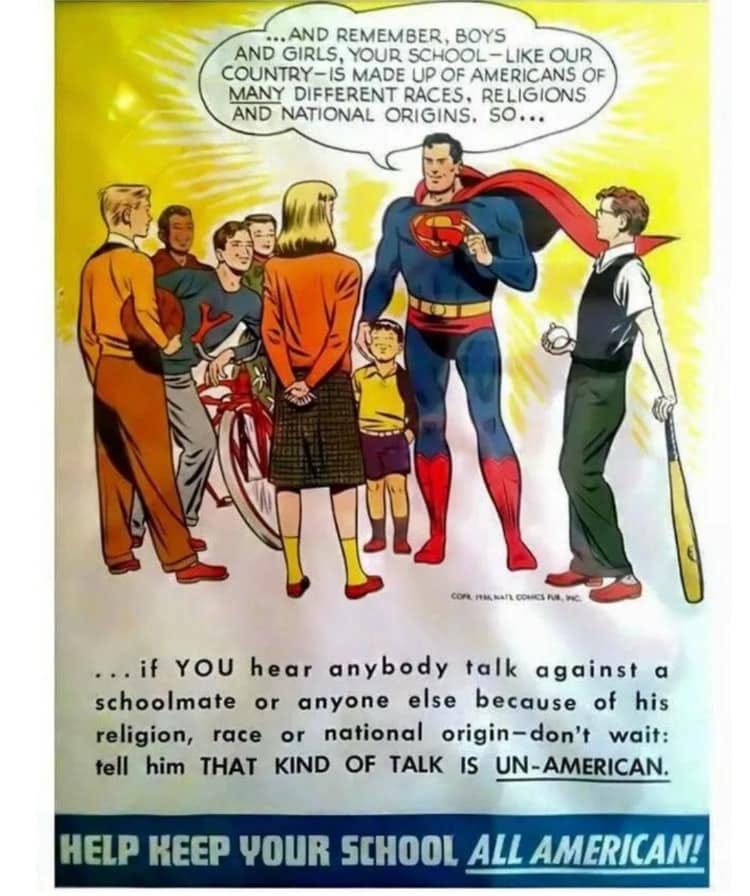
“We need to remain a nation that doesn’t just welcome, but celebrates legal immigrants who come here seeking a better life, seeking the American dream”.
-Ted Cruz, Canadian-born son of Cuban immigrant that “could not speak a lick of English when he got here”
Famous immigrants and children of Immigrants:
Juan Ciscomani (R-AZ) - born in Mexico.
Andrew S. Clyde (R-GA) - born in Canada.
Dan Crenshaw (R-TX) - born in Scotland.
Carlos A. Gimenez (R-FL) - born in Cuba.
Young Kim (R-CA) - born in South Korea.
David Rouzer (R-NC) - born in Germany.
Victoria Spartz (R-IN) - born in Ukraine.
Stephanie Bice, (R-OK) Iranian father
Mario Diaz-Balart, (R-FL) Cuban parents
Vince Fong, (R-CA) Chinese Parents
Carlos Gimenez, (R-FL) born in Cuba
Abraham Hamadeh, (R-AZ) Syrian parents
Andy Harris (R-MD) Ukrainian mother, Hungarian father
Kim Young (R-CA) born in South Korea
Anna-Paulina Luna (R-FL) Mexican father
Bernie Moreno (R-OH) born in Columbia
Jim Risch (R-ID) German father
Maria Elvira Salazar (R-FL) Cuban parents
Victoria Spartz (R-IN) born in Ukraine
John Thune (R-SD) Canadian Father
David Valadao (R-CA) Portuguese parents
Nikki Haley (Nimarata Nikki Randhawa Haley) - Child of immigrants (born to Punjabi Indian immigrants)
Marco Rubio - son of Cuban immigrants.
Donald J. Trump - Son of Scottish immigrant, grandson of German immigrants, husband of Slovenian immigrant to America
Not a single one of these politicians have made a statement I have been able to find against Trump’s immigration crackdown, the racism behind it, or the human rights abuses and degradation of our civil liberties that have taken place as a result of it.
I could also have used the DC area as an example, as it is plurality black but still has high levels of social trust.
I take a view similar to RBG’s view of affirmative action. In absence of a push towards full integration, color-conscious policies are useful as a temporary band-aid to ameliorate injustice and help a select group of minorities advance themselves. This is not only insufficient, however, it is also dangerous as it creates massive inequalities within minority groups while creating an impression of progress for the right, and cements social groups in people’s minds increasing tribalistic associations in all Americans with meaningless shared phenotypes, degrading trust and retarding social development.
This is endlessly complicated. The 1956 “Indian Relocation Act” encouraged Native Americans to move from Reservations to areas with more job opportunities (Read: Cities). It is worth noting that many of the initial migrants to urban areas struggled a lot and that 30% returned to reservations. However, by the 90’s hundreds of thousands of Native Americans lived in urban areas and make double what Native Americans on reservations do. This is after an effective campaign of providing reservations with greater economic autonomy.
Hispanic American’s also make less than the Average American but this seems to be because so many of them are recent migrants. Their income is rising at a trend comparable to other waves of largely destitute migrants. I also recognize that America is not color blind- but that should be the goal even as we recognize the enduring and unfortunate importance of color.
.Simon, thank you very much for taking the time to read Steinlight’s lengthy essay, for your thoughtful reply, and for offering additional survey info from Pew & Nature.
Before giving up on the idea that there are any political (voting) solutions to prevent the death of White Western culture, and people within modern America, I’d been studying up on Jewish behavior as a group. Jews, whether or not they temporarily adopt a “White” identity, for convenience in a majority-Christian culture, behave like non-Whites, not Whites. I am not so concerned with how others self-identify (i.e. a biological male who believes he’s been born into the “wrong” body) but with what actions/behaviors they take. When it comes to voting, as a group, White American gentiles are the ONLY group in America, in which the majority (currently ~60%) votes to protect free speech and to preserve our gun freedoms. Every other minority group, including Jews, vote ~70+% in favor of increasing “hate speech” (aka free, Constitutionally-protected, speech) penalties and increasing gun control. They may SAY they identify as “White” due to lighter-colored eyes, hair, skin than typical non-Europeans, but when outside the Jewish ethnostate of Israel, their priorities are to vote against, + actively destroy, what traditional founding stock heritage Americans, cherish the most.
We need a moratorium on all immigration to the U.S.
"I will then argue why diversity is our strength." ???
Here's 100+ studies showing you are dead wrong in your belief that diversity is a strength:
https://thuletide.wordpress.com/2020/08/06/diversity-meta-analysis/
You can start with this article, which is short & sweet from Aug 2007, featured in The Boston Globe, among other msm news:
The Downside of Diversity by Michael Jonas
http://archive.boston.com/news/globe/ideas/articles/2007/08/05/the_downside_of_diversity/?page=full